
Buy the book
Foreword by Ilan Pappé
Palestinian refugees in refugee camps for many years were reluctant to build their home with permanent materials such as stones lest it would convey a message that they are giving up their right of return.
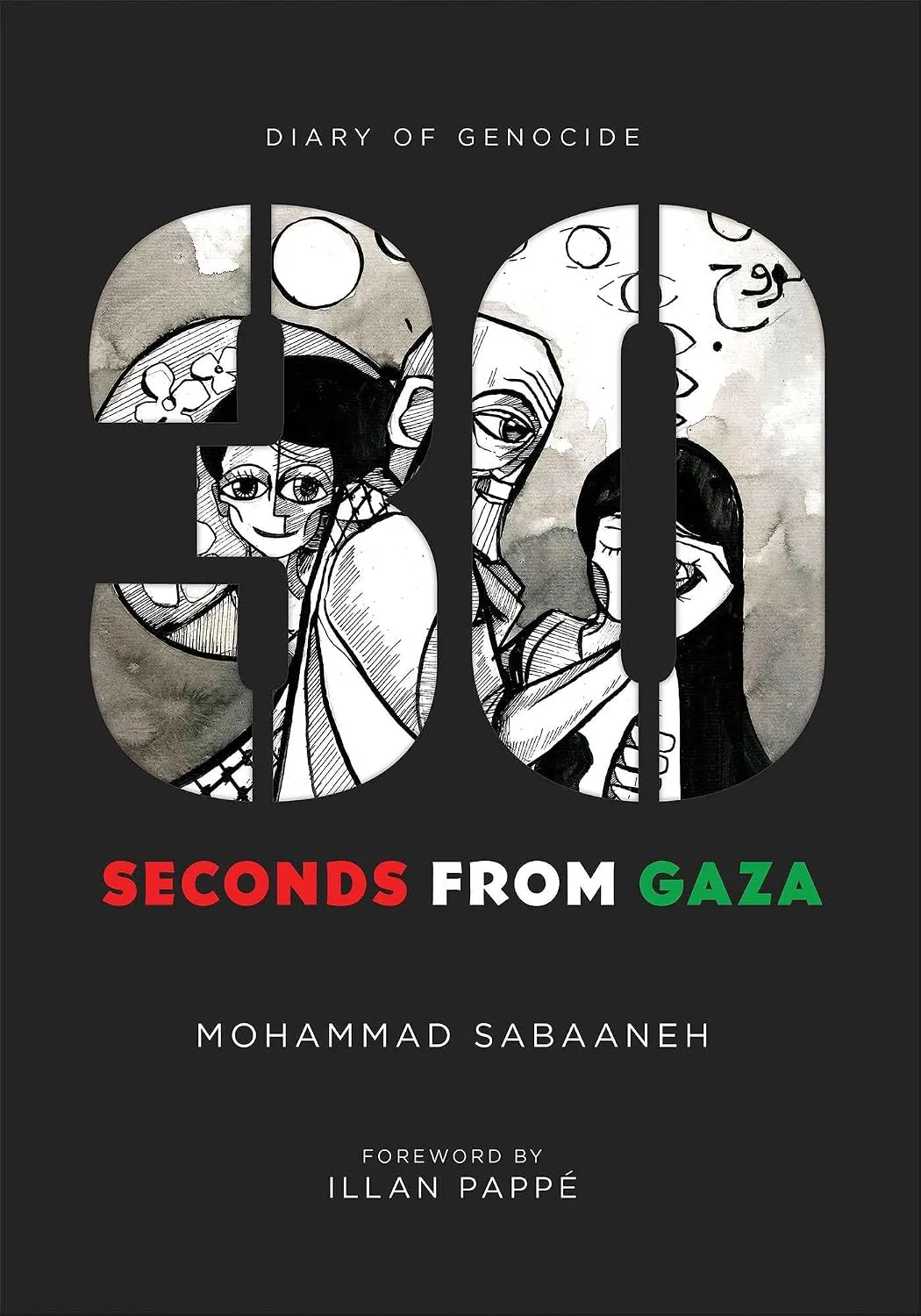
Mohammad Sabaaneh on the contrary uses Indian Ink because water can not erase it and it convey permanence.
Material realities are important part of the horrific journey, but one that has to be taken by anyone with a modicum of decency in them, into the geography of disaster and inhumanity that the Gaza Strip is since 7 October 2023 and quite frankly that Palestine has been for a very long time.
These powerful cubic images that will linger on with the readers for a very long time are first and foremost an act of salvaging. The act of salvaging, or rescuing, evidence is an integral part of denialism.
Read the full foreword
Palestinians were denied any right to Palestine even when they were still the only people there – when their fate was discussed and debated by a powerful alliance of Christian Zionist, Anglo Jewish aristocrats, British imperialists and Zionist leaders before the First World War.
This powerful coalition decided that the Palestinians were aliens in their homeland which belonged to the Jewish people who will ‘return’ with the help of this alliance and commence a project of displacement of the indigenous Palestinians and their replacement by Jewish settlers.
This project reached a climax with the help of the British in 1948. At that year, when the British mandate came to an end, the Zionist movement launched a massive operation of ethnic cleansing that ended with the destruction of half of Palestine’s villages, the expulsion of half of Palestine’s native population and the de-Arabization of most of Palestine’s towns. This all took place within nine months in 1948, a year referred to by the Palestinians as the Nakba, the catastrophe. The ethnic cleansing operation was accompanied by dozens of massacres, the most infamous of them is that of the village of Dir Yassin in April 1948.
At that time, Israel created the Gaza Strip as huge refugee camp into which it pushed hundreds of thousands of Palestine it expelled from the center and south of Palestine.
The international community was aware of the ethnic cleansing but remained silent, particularly the politicians and the press in the West who decided not to condemn a Jewish state for its crimes three years after the Holocaust.
This denial encouraged Israel to continue to use ethnic cleansing as a principal means for implementing its national security policy. Between 1948 and 1967, Israel expelled several villages within its territory and massively uprooted 300,000 Palestinians during the June 1967 war. Since 1967 and until recently, more than half a million Palestinians were ethnically cleansed from both the West Bank and the Gaza Strip.
In those years other means were employed by Israel to make life unsustainable for the unwanted millions of Palestinians it incorporated under its rule as it coveted the space and lands on which they lived. They included arrests without trial, house demolitions, burning of fields and uprooting of trees and other means of collective punishment. All these actions led to resistance and also to killings of many Palestinians.
This denial is at work also during the genocide of Gaza that began in October 2023. The historical context for what happened is denied and there a constant attempt to cover up the crimes of genocide on the ground.
The Palestinians and whoever supports their struggle are busy salvaging document and evidence from 1948 and from 2024 and all the years between them.
The evidence for the genocide is there in smartphones Palestinians used in a place where the mainstream media was hardly present and told a story that Israel is trying to falsify and erase.
And because META, the big giant that operates platforms such as Facebook and Instagram quite often erases such crucial evidence, Sabaaneh was alert to the danger that this videotaped and photographed coverage of the carnage would disappear.
The cubic drawings cannot be touched by any internet giants, or the Israelis and their permanent presence would be crucial for generations to come. They will remember and forget with the help of these images.
The most devastating images are those of children. In the months of October and November 2023 alone, five thousand and five hundred children were killed by Israeli forces in the Gaza Strip. Seven thousand children were wounded in those operations. The number doubled and tripled and grew with every passing month.
The numbers are hard to digest, each one has a name, a family (in many cases gone as well) and the intensity of the killing is such that the full list of names is still not with us, nor has everyone been recovered from under the rubble.
The enormity of the Gaza carnage has led many to forget that this Israeli violence towards children is not a one-off event but is part of a structural brutality. It happened before and is part of the overall violence inflicted by Israel, and before that by the Zionist movement, on the Palestinian people. Unfortunately, there is no sign or hope that this is the end of this carnage inflicted by Israel. It will continue for a while in the Gaza Strip and however, the war there ends, children will continue to be targeted by Israel also in East Jerusalem and the West Bank.
This violence is imbedded in the Zionist movement and in Israel. Violence that stems from the nature of the Zionist movement. As recent scholarship seems to agree the best way to frame this movement is to define it as a settler colonial movement. Settler colonialism, unlike classical colonialism, is a movement of usually European refugees who were unwelcomed in Europe – for religious reasons mostly - and sought to build a new Europe elsewhere in the world. They chose quite often, as happened in the case of the Jews who escaped from antisemitism in Europe to Palestine, a land inhabited by indigenous people.
The great and late scholar of settler colonialism, Patrick Wolfe, taught us two things about settler colonial movements which are relevant to this moving and heartbreaking book. The first is that at the moment of the encounter between the settler movement and the indigenous people, a logic, Wolfe called ‘the logic of the elimination of the native’, was activated. This means that the settlers saw the removal, and even the genocide, of the indigenous people as a pre-condition for the success of a building a new homeland for themselves. In North America elimination meant genocide, in other parts of the world it was translated, as in Palestine, to ethnic cleansing operations.
The second lesson we learn from Wolfe is that settler colonialism is not an event but a structure. Which means that the methods which the settler movement use to takeover someone’s else homeland, are maintained as long as the elimination of the native is incomplete.
This second observation of Wolfe can easily be applied to the history of the Zionist and later Israeli policy towards the Palestinians. The Zionist settlers began removing the Palestinians already in small numbers in the 1920s, through the purchase of land from absentee landlords on whose plots, Palestinian villages existed for centuries, and some time had been there even for more than thousand years.
It is difficult to get accurate statistics of child fatalities in the occupied territories before 2000. Since 2000, it is estimated that more than 3,500 children were killed by the Israeli forces (a figure that does not include babies who died at checkpoints, or for lack of nutrition or medical help).
Since 2006, it is the children of Gaza who more and more attract our attention, concern and devastation. The first brutal attack on them was in 2006, but a far most devastating bombardment was dropped on the people of Gaza in the operation 2009/2010.
This vicious assault has impact quite a few people around the globe who until then were aware of Palestine’s suffering but did not make it their focal point of activism or concern. This incredible group of artists, philanthropists from different part of the world could also not remain indifferent to the carnage then.
The drawings in this book speak for themselves, but they do need both historical and moral contexts. The events since October 2023 were in such a contextual need for anyone wishing to counter the Israeli propaganda and its supporters around the world that refused to see the Hamas attack in any context. This propaganda insisted the attack was a chapter in the history of antisemitism, even Nazism. This utter nonsense can only be countered by proper knowledge of the history of the Palestinian struggle, and by a firm moral stance that distinguishes between condemnable acts and their relations to justified struggle for liberation.
So, when you look at these images that eternalize snapshots remember few things. These are fractions of a long history of infanticide, orphanage and trauma, the Palestinian children and those of Gaza in particular have been experiencing for a very long time.
Secondly, some of these children grew out to be at the forefront of the Palestinian resistance, years later. I am always reminded of a photo of Zecharia Zbedi, a boy sitting on the ruins of his home in the Jenin refugee camp in 2002 after the massacre (Sabaaneh witnessed as well) Israel perpetrated there and seeing his photo years later as a commander in the liberation efforts in the camp. The link is obvious and clear.
Finally, these young human faces remind us that we are all supporting the Palestinian cause first and foremost as human beings who cannot stand by when other people, and in particular children, are denied normal life and are under constant existential danger. Those of them who will survive the Israeli brutality will be the future generation and will continue to lead the struggle for Palestinian liberation.
— Ilan Pappé
Press & Reviews
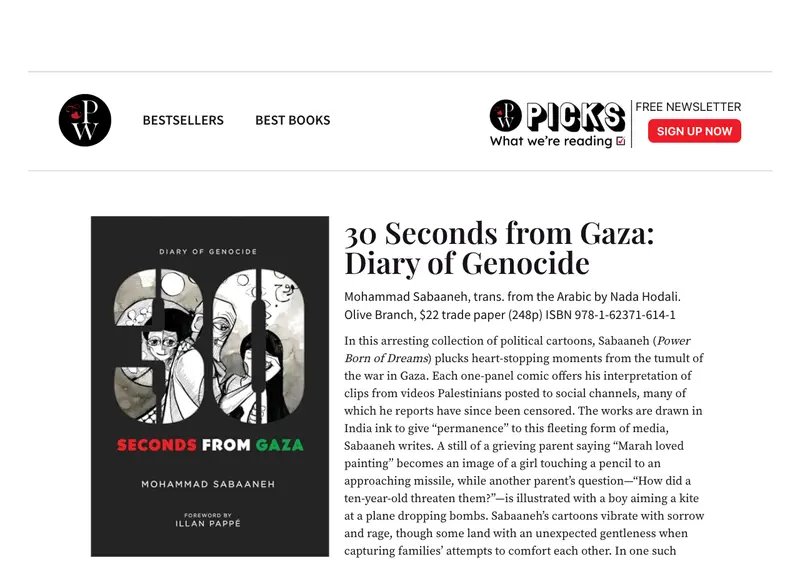
“By freezing these moments so beautifully in time, Sabaaneh refuses to let readers look away.”Publishers Weekly
“30 Seconds from Gaza is one of the most difficult books you will read this year, and for that very reason I urge you to do just that.”Andy Oliver, Broken Frontier
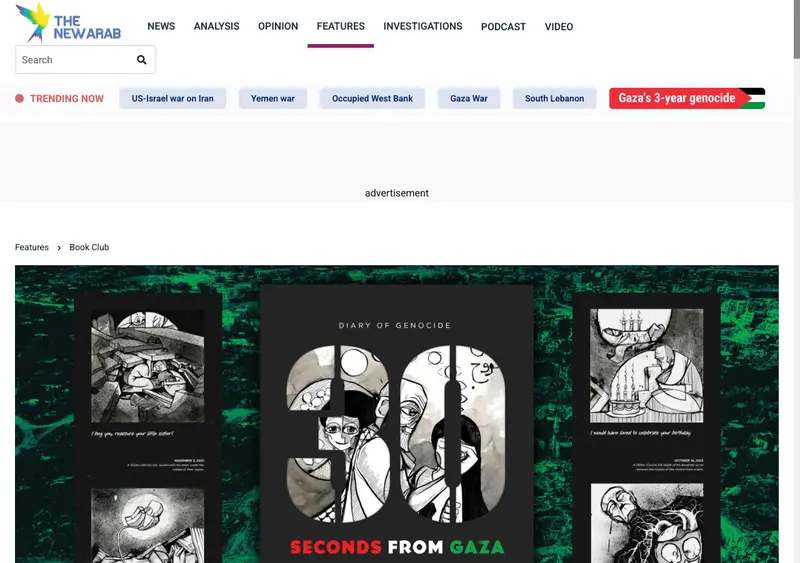
“Mohammad’s Cubist drawings in this collection occupy a unique place in memory, making them hard to forget.”Ramona Wadi, The New Arab
““30 Seconds From Gaza” è un’opera che trasporta artisticamente l’esperienza devastante vissuta dall’autore Mohammad Sabaaneh e dall’intero popolo palestinese.”Pina Fioretti, Invictapalestina
Covers


Pages


